
How Many First Aiders Does Your Sydney Workplace Need? A WHS Compliance Guide
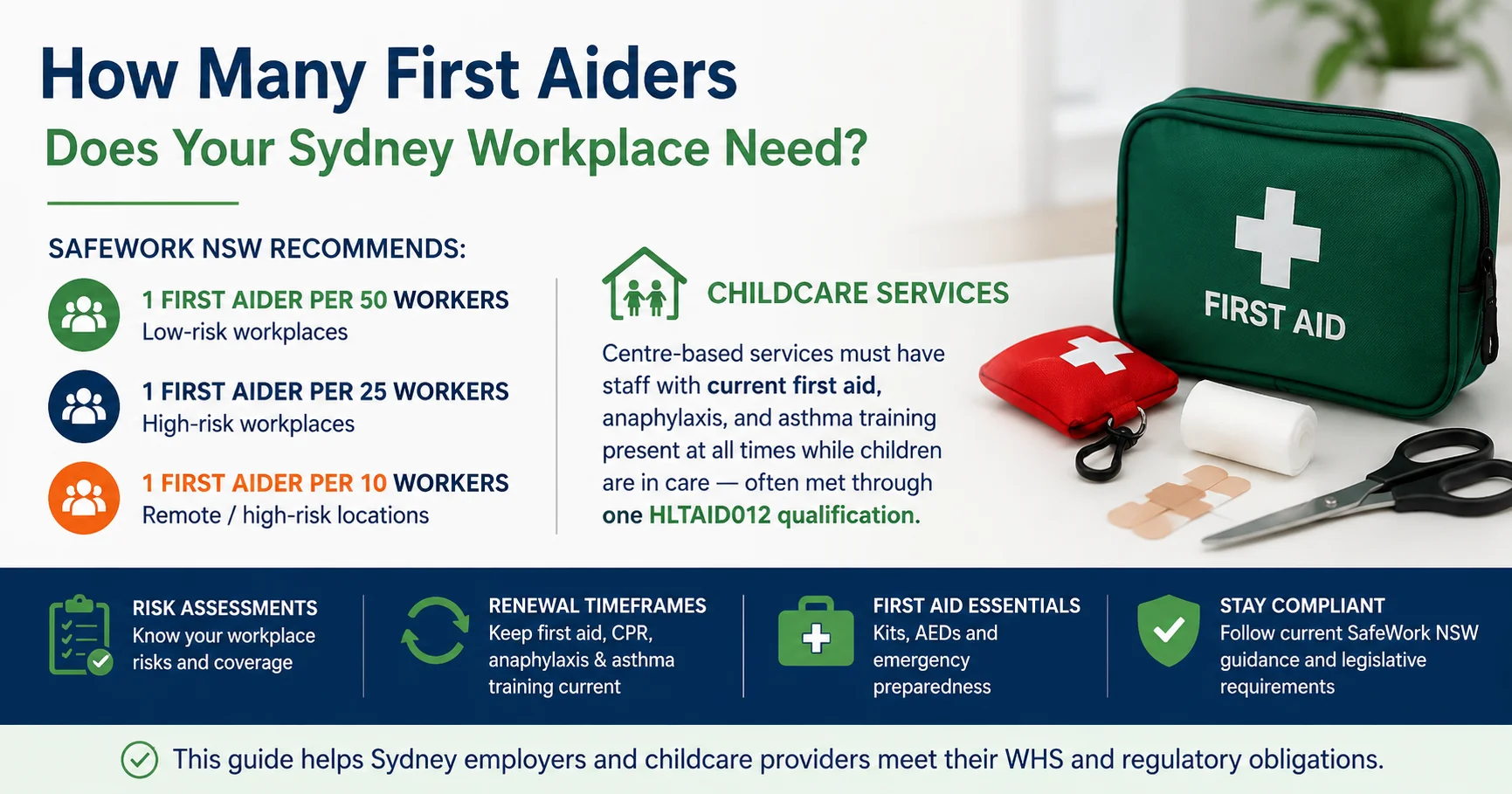
How many first aiders does your Sydney workplace need? SafeWork NSW recommends one per 50 workers in low-risk workplaces, one per 25 in high-risk workplaces, and one per 10 in remote high-risk locations. Centre-based childcare services must also have staff with current first aid, anaphylaxis, and asthma training available whenever children are in care, often covered through HLTAID012.
Every NSW business has a responsibility to provide suitable first aid arrangements for its workers. However, there is no single number of first aiders that applies to every workplace.
The appropriate number depends on factors such as workforce size, workplace hazards, operating hours, shift arrangements, location, and how quickly emergency services can reach the site.
This guide explains how Sydney businesses can assess their workplace first aid needs and understand the recommended first aider ratios.
Does Your Workplace Need Trained First Aiders?
Under NSW work health and safety requirements, workplaces must provide appropriate first aid equipment and facilities and, depending on the circumstances, access to trained first aiders.
For most workplaces where employees regularly work on site, having trained first aiders available is the most practical way to support compliance and ensure an effective response to injuries or medical emergencies.
The SafeWork NSW Code of Practice: First Aid in the Workplace provides recognised guidance for employers and other persons conducting a business or undertaking.
Although a Code of Practice is not a substitute for the WHS legislation, it provides an accepted way of meeting the required safety standards. Codes of Practice may also be referred to by inspectors and are admissible in court proceedings under the Work Health and Safety Act 2011.
Recommended First Aider Ratios
The number of trained first aiders required will depend on the workplace risk level and the maximum number of workers present at one time.
The SafeWork NSW Code of Practice provides the following recommended ratios as general guidance.
Low-Risk Workplaces
Examples include offices, libraries, small retail stores, and other environments where workers are not exposed to significant workplace hazards.
Recommended ratio: at least one trained first aider for every 50 workers.
High-Risk Workplaces
Examples include factories, construction sites, manufacturing facilities, warehouses, workshops, and workplaces involving machinery, hazardous substances, dangerous processes, or significant manual-handling risks.
Recommended ratio: at least one trained first aider for every 25 workers.
Remote High-Risk Workplaces
This category includes high-risk workplaces where medical assistance or ambulance services may not be available promptly because of distance, access limitations, or location.
Recommended ratio: at least one trained first aider for every 10 workers.
These ratios are recommendations rather than a fixed legal formula for every workplace. They should be used as a starting point and supported by a first aid needs assessment covering the workplace’s actual hazards, workforce, location, and operating arrangements.
Businesses should always check the current SafeWork NSW Code of Practice: First Aid in the Workplace before relying on these ratios. Codes, guidance documents, and regulatory requirements may be amended, and general articles may not reflect every update or workplace-specific circumstance.
When Might You Need More First Aiders?
Meeting the recommended ratio may not provide adequate coverage in every situation.
Additional trained first aiders may be required where a workplace has:
- Multiple shifts, including evening, overnight, or weekend work
- Workers located across separate floors, buildings, stores, or work areas
- Large numbers of customers, visitors, students, contractors, or members of the public
- Seasonal increases in worker numbers
- Remote work areas
- Delayed access to emergency services
- Higher-risk machinery, chemicals, processes, or manual-handling activities
- Workers travelling or working away from the main workplace
- First aiders who are frequently absent, working off site, or unavailable during breaks
The practical objective is to ensure that appropriate first aid assistance is available whenever workers are present.
For example, a business may have enough qualified first aiders in total but still have inadequate coverage if no trained first aider is rostered during a night shift, weekend operation, or at a separate work location.
Questions to Include in Your First Aid Needs Assessment
When reviewing your workplace arrangements, consider:
- What is the maximum number of workers present at one time?
- Are contractors, temporary workers, casual staff, or volunteers also present?
- Does the workplace operate across multiple shifts?
- Are workers spread across different buildings, floors, stores, or operational areas?
- Are members of the public regularly present?
- What types of injuries or medical emergencies could reasonably occur?
- How quickly could emergency services reach the workplace?
- Is an appropriately trained first aider available during every operating period?
- Are any first aid, CPR, asthma, or anaphylaxis certifications due to expire?
- Have recent incidents, near misses, or operational changes affected the workplace risk profile?
The answers should be documented and used to determine whether the current first aid arrangements are suitable.
What Qualifications Should Workplace First Aiders Hold?
For most general workplaces, the commonly recognised qualification is:
HLTAID011 – Provide First Aid
This nationally recognised course generally covers essential workplace first aid skills, including:
- Assessing an emergency
- DRSABCD procedures
- Cardiopulmonary resuscitation
- Using an automated external defibrillator
- Managing bleeding, burns, fractures, wounds, and shock
- Responding to common illnesses and medical emergencies
- Reporting and documenting first aid incidents
The qualification selected should be appropriate for the hazards and needs of the workplace.
First Aid and CPR Renewal Timeframes
Workplace first aiders should maintain current training.
The commonly applied renewal schedule is:
- HLTAID009 – Provide Cardiopulmonary Resuscitation: refresher training every 12 months
- HLTAID011 – Provide First Aid: renewed every three years
Employers should maintain a training register showing each first aider’s qualification, completion date, renewal date, work location, and roster availability.
Automated reminders can help prevent qualifications from expiring unexpectedly.
Childcare and Education Services
Education and care services have specific requirements under the Education and Care Services National Regulations that go beyond the general workplace first aid guidance.
For a centre-based service, Regulation 136 requires the approved provider to ensure that at least one staff member or nominated supervisor who meets each of the following requirements is in attendance and immediately available in an emergency while children are being educated and cared for:
- Holds a current approved first aid qualification
- Has undertaken current approved anaphylaxis management training
- Has undertaken current approved emergency asthma management training
These are legally distinct training requirements. A service must not assume that holding a general first aid qualification automatically satisfies the separate anaphylaxis and emergency asthma management requirements.
The requirements can be met by one person who holds all three current competencies or, where permitted by the applicable arrangements, by different people who collectively provide the required coverage. The service must maintain continuous coverage during operating hours, including staff breaks, leave, excursions, and unexpected absences.
How HLTAID012 Supports These Requirements
The commonly used childcare qualification is:
HLTAID012 – Provide First Aid in an Education and Care Setting
HLTAID012 typically incorporates first aid, CPR, anaphylaxis management, and emergency asthma management competencies relevant to infants and children. It can therefore provide a practical way for an educator to satisfy the three training areas, provided the course is currently approved and the required components remain current.
However, employers should verify the qualification against the current list of approved qualifications and training published by the Australian Children’s Education and Care Quality Authority.
Regulation 137 deals with the approval and determination of relevant qualifications, while Regulation 168 requires education and care services to maintain required policies and procedures, including policies relating to medical conditions. These provisions operate alongside the staffing and training requirements under Regulation 136.
For family day care services, each family day care educator and family day care educator assistant must hold or have undertaken the required current first aid, anaphylaxis management, and emergency asthma management training.
Approved first aid, anaphylaxis management, and emergency asthma management training are generally treated as current when completed within the previous three years, while CPR training must generally have been completed within the previous 12 months.
Construction Workplaces
Construction workplaces are generally considered high risk because of hazards involving machinery, tools, working at height, electricity, excavation, vehicles, manual handling, and changing site conditions.
First aid arrangements should reflect:
- The number of workers and contractors
- The site layout
- Shift arrangements
- The location of work crews
- Emergency access points
- Travel time for ambulance services
- The nature of the work being undertaken
Additional site-specific training or emergency arrangements may also be necessary.
Hospitality and Food-Service Workplaces
Restaurants, cafés, commercial kitchens, hotels, and catering operations may face hazards including:
- Burns and scalds
- Cuts and lacerations
- Slips and falls
- Choking
- Allergic reactions
- Manual-handling injuries
Training, first aid supplies, and emergency procedures should be matched to these risks.
Events and Public Venues
Event organisers should conduct a separate first aid needs assessment based on:
- Expected attendance
- Venue size and layout
- Event duration
- Crowd demographics
- Activities being conducted
- Alcohol availability
- Weather conditions
- Access for emergency services
- Distance to medical facilities
Larger or higher-risk events may require dedicated first aid personnel, treatment areas, communication systems, and documented emergency-response arrangements.
First Aid Requirements Go Beyond Staff Numbers
Having trained first aiders is only one part of an effective workplace first aid system.
Employers must also consider equipment, facilities, communication, emergency access, and record-keeping.
First Aid Kits
First aid kits should be:
- Easily accessible
- Clearly identified
- Located close to relevant work areas
- Suitable for the hazards present
- Regularly inspected and restocked
- Checked for expired or damaged contents
- Protected from contamination and unauthorised use
Additional items may be appropriate for specific workplace risks, including:
- Burn dressings for kitchens and workshops
- Eye-wash equipment for chemical, dust, or debris exposure
- Trauma dressings for high-risk workplaces
- Vehicle or outdoor first aid kits
- Emergency blankets
- Snake-bite bandages where relevant
Automated External Defibrillators
An automated external defibrillator can improve the chance of survival following sudden cardiac arrest.
Where an AED is provided, it should be:
- Clearly signed
- Easy to access
- Included in workplace emergency procedures
- Regularly inspected
- Maintained according to the manufacturer’s instructions
- Supported by appropriate worker awareness and training
First Aid Rooms
A dedicated first aid room may be appropriate for larger or higher-risk workplaces.
The room should be accessible, clearly identified, adequately equipped, maintained appropriately, and reserved for first aid purposes where required.
Emergency Communication
Workers should know:
- Who the workplace first aiders are
- How to contact them
- Where first aid kits are located
- Where the AED is located
- How to contact emergency services
- Where emergency access and assembly points are
- How injuries and first aid treatment should be reported
This information should be incorporated into worker induction and emergency training.
First Aid Record-Keeping
Employers should maintain appropriate records relating to:
- First aid treatment provided
- Workplace injuries and medical incidents
- Training and certification
- First aid kit inspections
- AED inspections and maintenance
- Workplace risk assessments
- Emergency exercises
- Corrective actions following incidents
Records involving personal or medical information should be stored securely and handled in accordance with applicable privacy requirements.
Incident records can also help identify recurring hazards and determine whether additional controls, equipment, staffing, or training are needed.
How Often Should First Aid Arrangements Be Reviewed?
First aid arrangements should be reviewed regularly and whenever significant workplace changes occur.
A review may be necessary when:
- Workforce numbers increase
- New equipment or machinery is introduced
- Work processes change
- New chemicals or hazardous materials are used
- The workplace moves, expands, or adds another location
- Shift structures or operating hours change
- An incident or near miss occurs
- A trained first aider leaves or changes roles
- Qualifications expire
- Emergency service response times change
- Regulatory requirements or Codes of Practice are updated
An annual review is a practical minimum for many businesses, although high-risk workplaces may need more frequent reviews.
A Simple Workplace First Aid Checklist
Use the following process to review your workplace arrangements:
- Count the maximum number of workers present at one time, including contractors and casual staff.
- Determine whether the workplace is low risk, high risk, or a remote high-risk workplace.
- Review the latest SafeWork NSW Code of Practice.
- Apply the recommended first aider ratio as an initial guide.
- Increase coverage where required for shifts, separate locations, visitors, or delayed emergency response.
- Confirm that trained first aiders are available during all operating hours.
- Check first aid, CPR, anaphylaxis, and asthma training expiry dates where applicable.
- Inspect first aid kits and replace missing, damaged, or expired items.
- Confirm that first aid kits and AEDs are clearly signed.
- Ensure workers understand how to request assistance.
- Document the assessment, actions taken, and next review date.
Train Your Sydney Workplace First Aiders
Having appropriately trained first aiders helps businesses respond effectively to workplace injuries and medical emergencies while supporting their WHS responsibilities.
Sydney ABC First Aid provides nationally recognised first aid training for individuals, businesses, childcare services, and workplace teams.
Available courses include:
- HLTAID009 – Provide Cardiopulmonary Resuscitation
- HLTAID011 – Provide First Aid
- HLTAID012 – Provide First Aid in an Education and Care Setting
Training is available across Sydney CBD, Kogarah, Bankstown, and Blacktown, with group and onsite training options for organisations that need to train multiple employees.
View available first aid courses or contact Sydney ABC First Aid to discuss workplace, childcare, group, or onsite training.
Disclaimer: This article provides general information only and does not constitute legal, regulatory, or work health and safety advice. Requirements may vary according to the workplace, industry, service type, operating arrangements, and applicable legislation. Businesses and education and care services should consult the current SafeWork NSW Code of Practice, the Education and Care Services National Regulations, ACECQA’s approved qualification information, and professional WHS or regulatory advice where necessary.